
Your Rental Property Doesn’t Have to Be a Cash Flow Machine to Build Wealth
Imagine investing $80,000 in a rental property that produces just $300 a month in cash flow. That’s $3,600 a year on an $80,000 investment – a 4.5% return. Not exactly the kind of number that gets people excited.
But what if that same property was also building thousands of dollars in equity every year, growing in value, and lowering your tax bill at the same time?
That’s the part many first-time investors miss. When people start shopping for their first rental, they tend to focus almost entirely on one number: monthly cash flow. Cash flow matters – a lot. But it only tells part of the financial story.
Real estate offers several wealth-building advantages that most other investments don’t, and they work at the same time. Understanding all of them will help you make smarter buying decisions and set realistic expectations before you make an offer.
Let’s look at the six ways a rental property can build wealth.
The Six Ways Rental Properties Build Wealth
1. Monthly Cash Flow: Getting Paid to Own the Property
Cash flow is what’s left over after the rent comes in and all the bills are paid. If the rent covers every expense with money to spare, you have positive cash flow. If you have to reach into your own pocket each month to keep the property running, you have negative cash flow.
It helps to separate two numbers:
- Gross rental income is the total rent you collect.
- Net rental income is what remains after operating expenses.
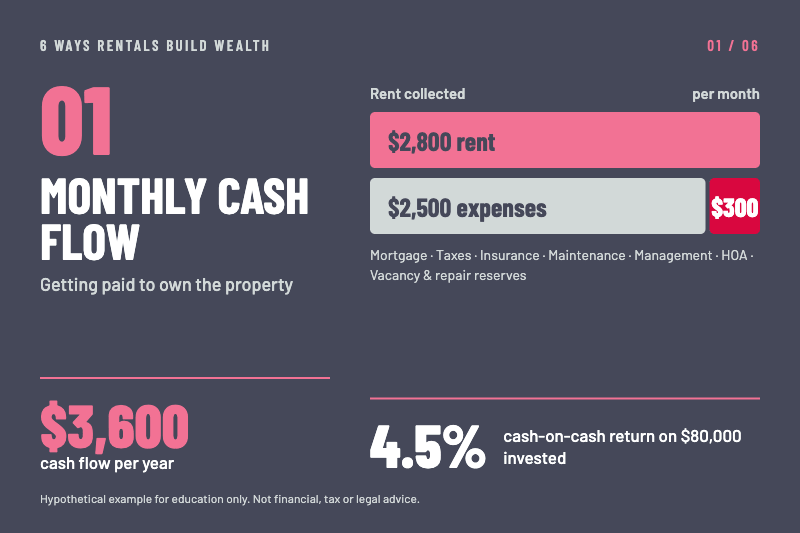
Those expenses add up faster than many new investors expect. A realistic budget includes the mortgage payment, property taxes, insurance, routine maintenance, property management, HOA fees (if any), an allowance for vacancies, and reserves for bigger repairs down the road.
Here’s a simple example. A rental brings in $2,800 a month in rent, and total monthly expenses come to $2,500. That leaves $300 a month – or $3,600 a year – in cash flow.
A useful way to measure this is cash-on-cash return: your annual cash flow divided by the cash you invested. In this case, $3,600 ÷ $80,000 = 4.5%.
Cash flow gives your investment financial stability. It covers surprises, keeps you from feeding the property every month, and lets you hold on through slower markets.
Key takeaway: Cash flow helps sustain an investment, but it isn’t the only way the property produces a return.
2. Mortgage Principal Reduction: Letting Your Tenant Build Your Equity
Every mortgage payment has two parts. Interest is the cost of borrowing the money. Principal is the portion that actually pays down your loan balance.
Each month, part of the rent your tenant pays goes toward that principal. As the balance drops, your equity – the share of the property you truly own – grows. And because the mortgage payment is already included in your expenses, this equity builds without you putting in any additional money.
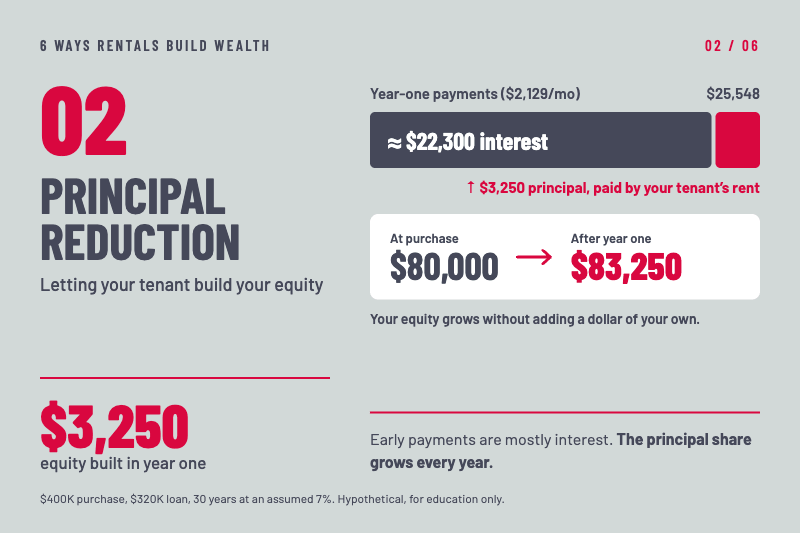
Say you buy a $400,000 property with $80,000 down and a $320,000 mortgage. On a 30-year loan at an assumed 7% interest rate, the monthly principal and interest payment is about $2,129. In the first year, roughly $3,250 of those payments goes toward principal.
That amount grows every year. Early in a loan, most of each payment goes to interest. Over time, the balance shifts, and more of each payment chips away at principal.
Key takeaway: Your tenant’s rent can help pay down your mortgage and increase your net worth.
3. Property Appreciation: Building Wealth as Real Estate Values Increase
Appreciation is the increase in a property’s market value over time. It’s driven by things like buyer demand, location, job and population growth, and a limited supply of homes in desirable areas.
Here’s where financing becomes powerful. When you buy with a mortgage, you control the full value of the property while investing only a fraction of the price.
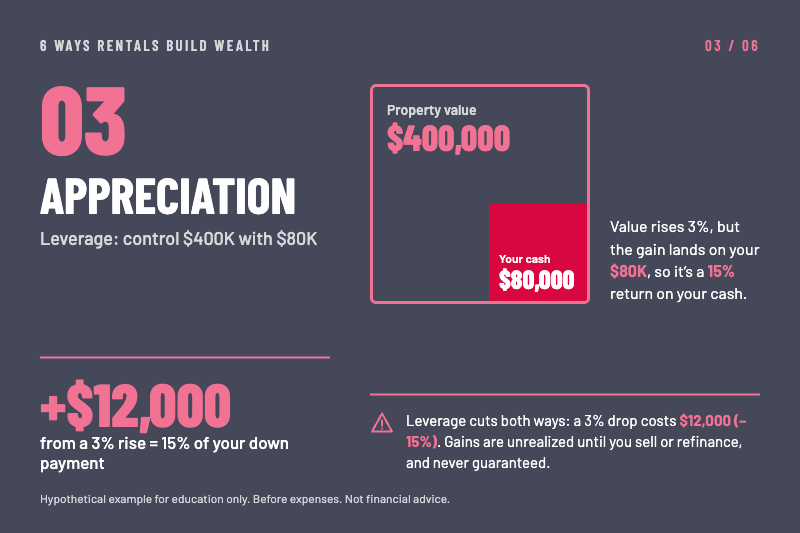
If a $400,000 property appreciates 3% in a year, its value rises by $12,000. But you didn’t invest $400,000 – you invested $80,000. That $12,000 gain equals 15% of your down payment, before expenses. Keep in mind that this is an unrealized gain; you don’t actually collect it until you sell or refinance.
Leverage cuts both ways, though. If that same property dropped 3% in value, you’d lose $12,000 in equity – 15% of your down payment. Appreciation is never guaranteed, and property values can and do decline.
Key takeaway: Financing can magnify your return on invested capital, but it also magnifies downside risk.
4. Tax Advantages: Keeping More of Your Rental Income
Rental property comes with some of the most attractive tax benefits available to everyday investors. Common deductions include:
- Mortgage interest on the loan used to buy the property
- Property taxes
- Operating expenses such as insurance, maintenance, repairs, property management, and HOA fees
- Depreciation on the building
- Qualifying improvements, which are typically depreciated over time rather than deducted all at once
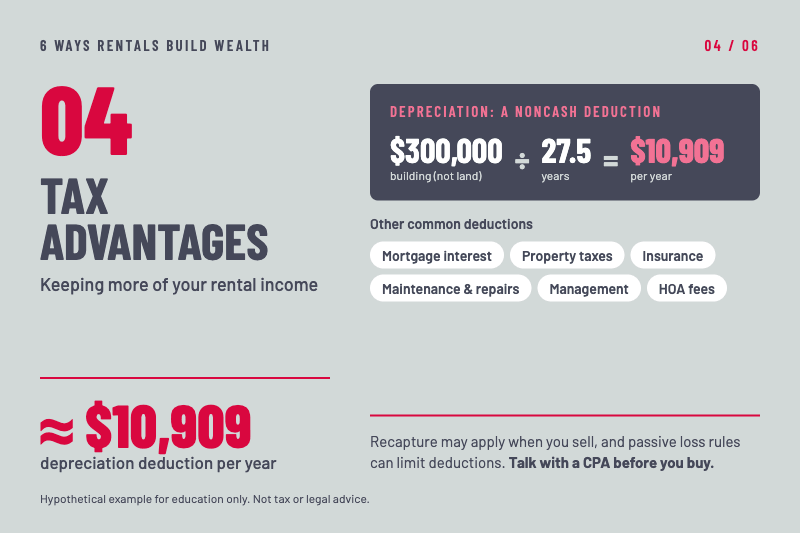
Depreciation deserves special attention. The IRS generally allows residential rental buildings to be depreciated over 27.5 years. Land can’t be depreciated – only the building can.
For example, if your property has a $300,000 depreciable building basis, you may be able to deduct roughly 10,909peryear(300,000 ÷ 27.5), subject to applicable rules.
What makes depreciation unique is that it’s a noncash expense. You don’t write a check for it, yet it can reduce your taxable rental income. In many cases, a property with positive cash flow can show little or no taxable income on paper.
There are important limits to understand:
- Passive activity loss rules may restrict your ability to use rental losses to offset income from your job, especially at higher income levels.
- Depreciation recapture means that when you sell, the depreciation you claimed may be taxed – so the benefit is often a deferral, not a permanent exemption.
Key takeaway: Tax deductions can improve your after-tax returns, but tax treatment depends on your personal circumstances. Talk with a qualified CPA before you purchase an investment property.
5. Rental Income Growth: Increasing Returns Over Time
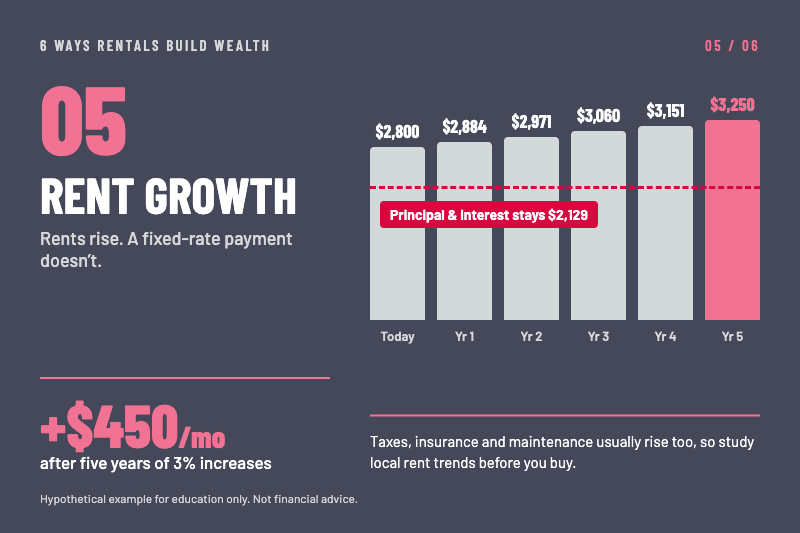
Market rents tend to rise over time, while a fixed-rate mortgage keeps your principal and interest payment the same for the life of the loan. That combination is one of the quiet advantages of long-term ownership.
If the property from our earlier example rents for $2,800 a month today, five years of 3% annual rent increases would bring it to roughly $3,250 a month. That’s about $450 more each month, with the same principal and interest payment.
Of course, your costs don’t stand still either. Property taxes, insurance premiums, and maintenance expenses typically rise too. Strong rent growth also depends on steady tenant demand and healthy neighborhood rental trends, so it’s worth studying how rents have moved in the area before you buy.
Key takeaway: Increasing rental income can make a well-purchased property more profitable over time.
6. Forced Appreciation: Increasing Property Value Through Improvements
Market appreciation happens to you. Forced appreciation is value you create yourself through smart improvements and better management.
That might include:
- Cosmetic updates like paint, flooring, and lighting
- Kitchen and bathroom improvements
- Outdoor amenities such as a patio, fencing, or landscaping
- Better property management that reduces turnover and tightens up expenses
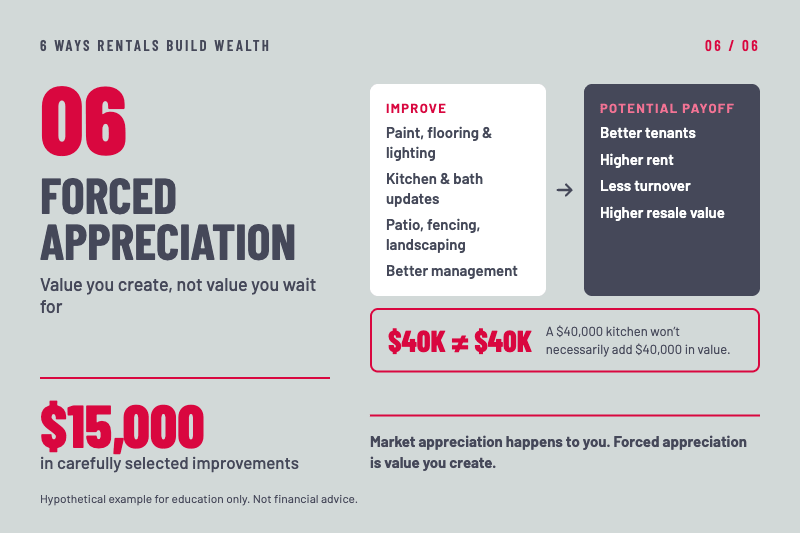
For example, investing $15,000 in carefully selected improvements could attract better tenants, support higher rents, and potentially increase the property’s resale value.
The catch: improvements don’t always pay for themselves dollar-for-dollar. A $40,000 kitchen won’t necessarily add $40,000 in value or justify much higher rent. Always factor renovation costs into your return calculations, and focus on upgrades your target tenants actually value.
Key takeaway: Investors can sometimes create additional value instead of relying entirely on market appreciation.
Putting It All Together – A $400,000 Rental Property Example
The six concepts above make more sense when you see them working on the same property at the same time. Here’s a hypothetical first rental purchased with a conventional loan and 20% down.
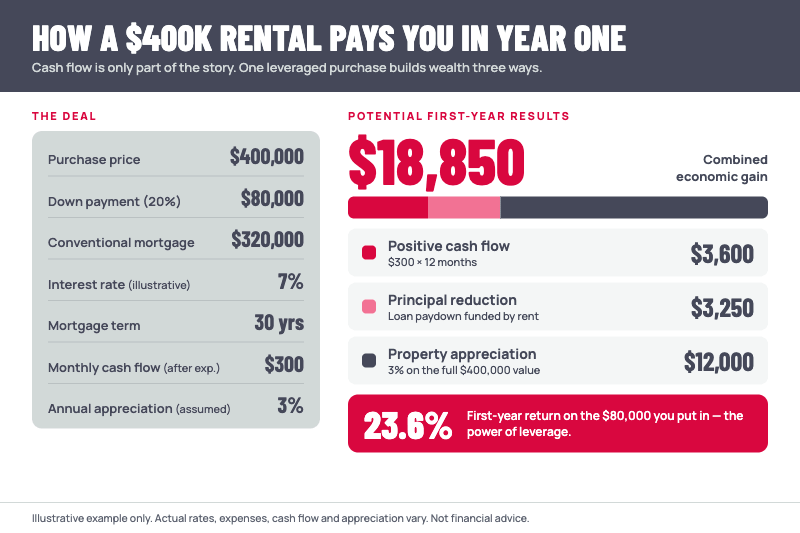
This is the most important lesson in the article. The investor collects just $3,600 in cash flow, but the property may produce about $18,850 in combined first-year economic gains. That’s roughly 23.6% of the $80,000 down payment.
Now the fine print, because it matters:
- This is not a 23.6% cash-on-cash return. Only $3,600 of it is cash in your pocket.
- It’s not a complete ROI calculation. It assumes 3% appreciation, which isn’t guaranteed.
- It leaves out real costs. Closing costs, inspections, initial repairs, and reserves would raise your total investment above $80,000. Selling costs, taxes, and major capital expenses aren’t included either.
The actual return could be lower – or even negative. The point isn’t the exact figure. It’s that a property with modest cash flow may be building wealth in several other ways at the same time.
Tax benefits, rent growth, and forced appreciation aren’t counted here at all. Over a longer holding period, those can add meaningfully to the total.
Understanding the Financial Metrics That Matter
You don’t need to be a financial analyst to buy your first rental. But knowing a handful of key terms will help you compare properties and have better conversations with your lender, CPA, and real estate broker.
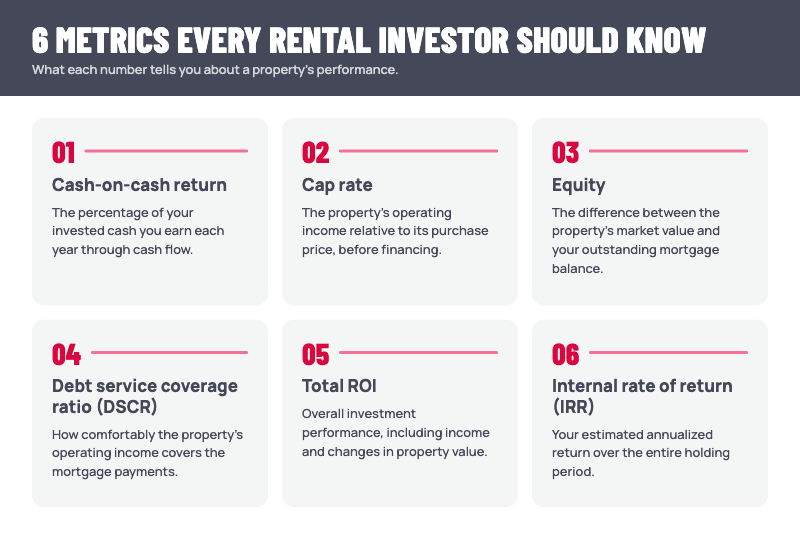
You don’t need to master the formulas today. Just know that no single metric tells the whole story – which is exactly the point of this article.
Risks Every First-Time Investor Should Understand
Everything above describes what can go right. A smart investor also plans for what can go wrong.
Negative cash flow and unexpected vacancies
A few months without a tenant can wipe out a year’s worth of cash flow. Extended vacancies drain reserves quickly, and an unexpected repair during a vacancy can turn a profitable property into a monthly expense.
Unexpected major expenses
Some of the costliest surprises include:
- Roof replacement
- HVAC failures
- Plumbing or structural repairs
- Property insurance increases
- HOA special assessments
These aren’t rare events. Over a long enough holding period, most owners will face at least one of them, which is why capital expenditure reserves belong in your budget from day one.
Market declines
Property values don’t always go up, and rental demand can weaken when local economies slow down. A property that only works if prices keep rising isn’t a strong investment. Never depend on appreciation alone.
Buying and selling costs
Closing costs increase your upfront investment, and selling costs – commissions, transfer taxes, and concessions – reduce your realized profit. If you sell after only a year or two, those transaction costs can erase much of your gain. Real estate rewards patience.
Key takeaway: A strong investment should be able to withstand reasonable financial stress, not just perform well under ideal conditions.
How to Evaluate Your First Rental Property Before Making an Offer
Before you write an offer, work through this checklist:
- Estimate realistic rent using comparable rentals nearby – not the seller’s best-case number.
- List every operating expense, including taxes, insurance, HOA fees, management, and maintenance.
- Budget for vacancies and capital expenditures, such as a future roof or HVAC system.
- Calculate your full upfront investment, including closing costs, inspections, and initial repairs.
- Determine your expected monthly cash flow after all of the above.
- Estimate principal reduction over your intended holding period.
- Model conservative appreciation and rent growth. If the deal only works with optimistic assumptions, it’s not a good deal.
- Review potential tax benefits with a CPA.
- Project your returns over 5 and 10 years, not just year one.
- Stress-test the numbers. What happens if rent drops 10%, the property sits vacant for three months, or you face a $10,000 repair?
- Plan your exit strategy before you buy – whether that’s selling, refinancing, or holding long-term.
Think Like a Long-Term Investor, Not Just a Landlord
Successful rental property investing isn’t necessarily about finding the property with the biggest monthly check. It’s about understanding how cash flow, mortgage principal reduction, appreciation, tax advantages, rent growth, and strategic improvements work together to build wealth.
The most attractive investment is often the one that balances predictable rental income, manageable risk, and long-term equity growth.
A rental that produces a few hundred dollars a month might not look exciting at first. But once you understand everything happening behind the scenes, it becomes clear why real estate remains one of the most popular long-term wealth-building strategies.
The key is buying the right property, understanding the numbers, and going in with realistic expectations.
Thinking about purchasing your first investment property?
Understanding the numbers before you make an offer can make all the difference. Whether you’re considering a traditional long-term rental or a short-term vacation rental, working with a real estate broker who understands investment fundamentals can help you evaluate opportunities and avoid costly mistakes.
Let’s talk about your investment goals and explore properties that may be a good fit.

About the author:
Jeff Hamm is a North Carolina real estate broker who helps clients buy investment properties for long-term and short-term rentals in two of the state’s strongest rental markets: Lake Norman and the greater High Country region.
Whether a buyer wants steady year-round income from a long-term lease or the higher returns of a vacation rental, Jeff helps them find property that fits their goals.
Connect with the best real estate agents in your area.
This article is for educational purposes only and isn’t financial, tax, or legal advice. The examples are hypothetical. Consult a qualified CPA, lender, and financial advisor before making investment decisions.